1. The Global Admissions “Black Hole”
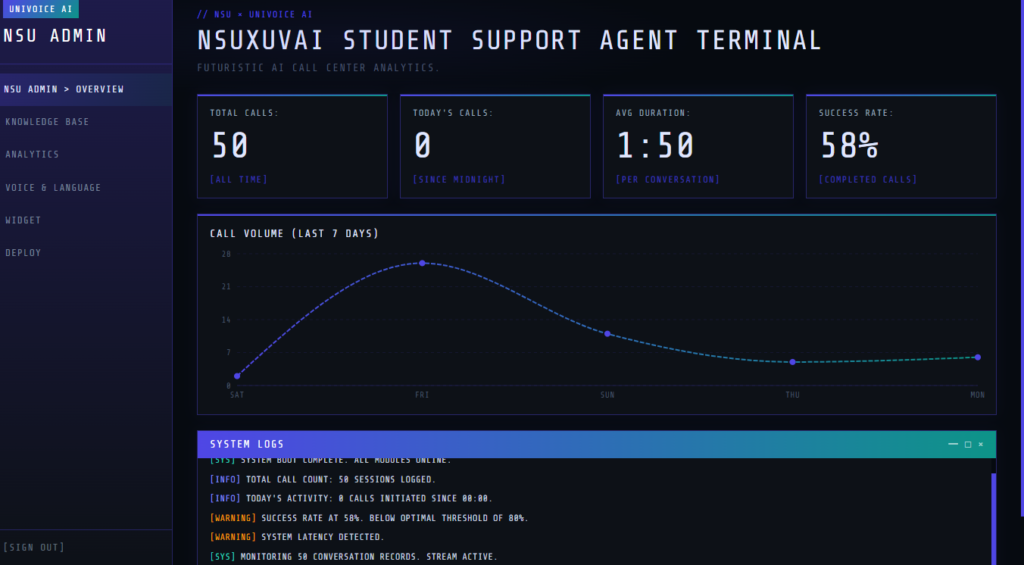
In the hyper-competitive landscape of international student recruitment, the margin for error has narrowed to a razor’s edge. Institutions today invest millions in global marketing and sophisticated outreach, yet much of that potential disappears into an admissions “black hole.” This phenomenon occurs when qualified, high-intent applicants are met with silence. Traditional support channels—static chatbots, overflowing email queues, and exhausted human staff—regularly leave international students waiting days for answers regarding visas, entry requirements, and deadlines.
This delay is more than a logistical bottleneck; it is a silent killer of Brand Equity. When a prospective student in a different time zone reaches out and receives no response, they do not simply wait. They pivot. They move to the competitor who answers first. We are witnessing an institutional crisis where outdated infrastructure cannot keep pace with the expectations of a digital-native global audience, leading to the “silent” loss of enrollment yield. Here comes UniVoiceAI, where no minute is delayed, and you receive any types of information regarding admission through a voice agent instantly
2. Yield Optimization and the 12% Rule
In modern admissions, speed is the ultimate competitive advantage. For a strategist, the data regarding response latency is sobering. We track what we call the “12% Rule”:
“Students choose the school that responds first. Every hour of delay can lower your yield by about 12% in competitive markets.”
While traditional human-led responses or legacy CRM automations may take hours or days to process a single inquiry, UniVoice AI operates on a temporal scale that matches student demand. By delivering a 3-second response time, the platform eliminates the “frustration and uncertainty” that triggers applicant attrition. In an environment where every hour counts, the ability to engage a lead with a real-time vocal response—rather than a 24-hour delayed email—is the difference between a filled seat and a lost opportunity.
3. Beyond Translation: The Auditory Trust of Native Scaling
True global engagement requires more than simple text translation; it requires cultural and vocal resonance. UniVoice represents a shift from “scripted chatbots” to true Conversational Intelligence. This technology understands the nuance of context, tone, and intent, providing an experience that feels fundamentally human.
- Multilingual Mastery: UniVoiceAI provides native-level scaling in English, Bengali, Arabic and 20 more Languages, allowing institutions to speak to students in their preferred tongue with natural accents.
- Reduced Cognitive Load: For non-native speakers, navigating complex institutional policies in a second language creates significant “mental strain.” Hearing a warm, native-accented voice provides an auditory clarity that text cannot match.
- Building Auditory Trust: “Warm audio” builds immediate institutional trust. It transforms a cold transaction into a Frictionless Onboarding experience, making the institution feel accessible rather than bureaucratic.
4. The “50% Growth Case”: A Compounding Funnel
The impact of UniVoice AI is not merely additive; it is a compounding force across the entire enrollment funnel. By applying a four-engine framework, institutions can achieve a net 50% growth effect in international intake without increasing marketing spend.
- Capture: 24/7 vocal support ensures no inquiry is missed, regardless of the student’s time zone or language.
- Convert: Instant, accurate voice interactions build the trust necessary for students to complete the high-friction stages of their application.
- Intervene: This is a revolutionary shift from reactive to proactive support. The predictive engine identifies “at-risk” applicants who have stalled in the funnel and prompts outreach before they drop off.
- Retain: Automated post-arrival guidance and support improve first-year retention, turning satisfied students into a source of referrals.
When an institution optimizes each stage by just 15–20%, the compounding result is a transformative 50% increase in total international student intake.
5. Operational Scaling: Amplifying Teams, Not Replacing Them
A primary concern for administration is the “AI replacement” anxiety. However, the most successful implementations of UniVoice AI follow a “Human-AI Collaboration” model. The AI handles the 70–80% of repetitive, high-volume interactions—questions about transcripts or visa forms—allowing human advisors to focus on high-value, high-complexity counseling.
The Strategic Comparison: Before vs. After AI
| Feature | Traditional Admissions (Before) | uniVoice AI Integration (After) |
| Response Time | Hours or days | Under 3 seconds |
| Capacity | 150–200 inquiries per advisor/month | Unlimited concurrent interactions |
| Availability | Local business hours only | 24/7 Global coverage |
| Language | One language per advisor | Universal native language support |
| Cost Basis | High (salary + physical infra) | 40–60% lower operating cost |
| Automation | 0% (manual queueing) | 80%+ auto-resolution rate |
As Devin Purgason, Associate Vice President at Tech Community College, notes:
“AI is not here to replace us — it’s here to help us give better, faster support.”
6. Radical Efficiency: Institutional Proof Points
The transition to voice-first AI delivers measurable ROI often within the first intake cycle. With a setup time of only 2–4 weeks, the impact on the bottom line is immediate.
- Harrington Business School (Toronto, Canada): Recovered CAD $2.1 million in revenue by cutting visa-related anxieties and increasing yield by 18 percentage points.
- Midlands University (UK): Saw response times plummet from 14 days to just 3 hours, fueling a 38% increase in international enrollment.
- East Delta University Consortium (Dhaka, Bangladesh): Scaled from zero to 312 international students while realizing a 73% cost saving.
- Southeast State University (USA): Saved an estimated 160,000 minutes of staff time through admissions automation.
- Nordvik University of Technology (Sweden): Achieved 117% enrollment growth with zero new staff hires.
Furthermore, pilot data from a Tier 1 institution in Bangladesh demonstrated a 50% faster response time, proving that the “3-second advantage” is a global reality.
7. Institutional Safety in a Digital World
In an era of AI “hallucinations,” accuracy is a non-negotiable requirement for higher education. UniVoice AI maintains safety by using an institution’s own documents, policies, and knowledge base as the exclusive source of truth. This ensures every vocal interaction remains “on-brand” and factually precise.
Security is handled via a “Privacy-by-Design” philosophy. The platform is fully FERPA compliant for U.S. student records and GDPR ready for European Union data standards. By utilizing strong encryption and rigorous access controls, UniVoice ensures that sensitive applicant data remains protected throughout the student journey.
8. Conclusion: The Window of Opportunity
The shift from being an “overwhelmed” admissions office to a student-first leader is no longer a luxury; it is a competitive necessity. Institutions that adopt Conversational AI today are not just solving a workflow problem—they are owning mindshare in the world’s fastest-growing regions, from South Asia and MENA to LatAm.
The window to lead this transformation is currently open, but it is closing. As your competitors move toward instant, multilingual engagement, the opportunity cost of maintaining the status quo grows by the hour. For university administrators, the question is no longer whether to adopt AI, but whether your current infrastructure can survive the next global intake cycle without it. Will you capture the leads of tomorrow, or will they continue to vanish into the black hole of delay?